Solitaire Card Game
Degoo ltdCard
4.82.88K Reviews
- Version
- 2.4.10
- Installs
- 5.00M
- Age Rating
- Everyone
Screenshots
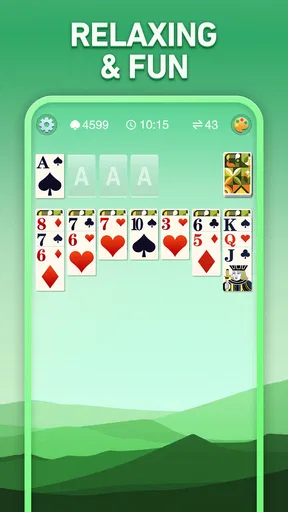
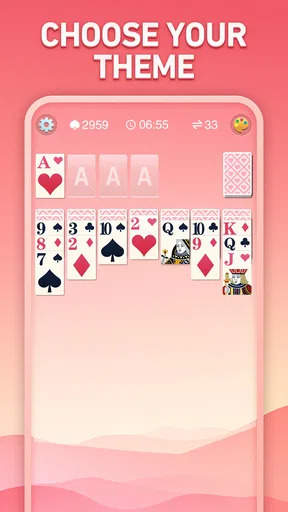
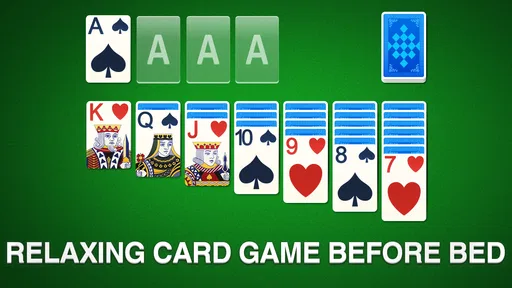
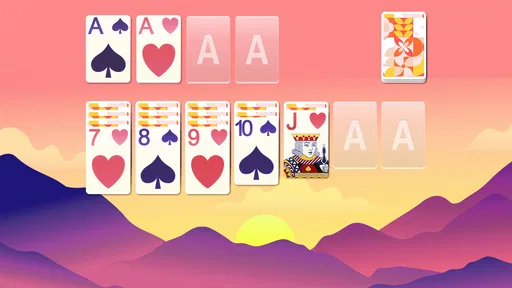
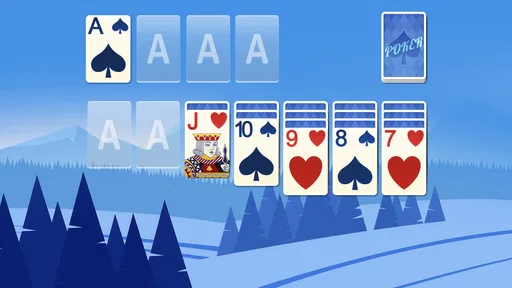
Our Review of Solitaire Card Game
 Analysis by Appyee
I like card games that respect my time, and Solitaire Card Game largely gets that balance right. Developed by Degoo ltd, this free card game focuses on familiar solitaire play rather than trying to turn a quiet puzzle into a complicated social platform. I can open it for a short break, play without an internet connection, and leave whenever I want without feeling that I have abandoned a long campaign. That simple approach is the main reason I would recommend it to people who want a calm way to keep their mind occupied.
My overall view is positive but specific: this is best understood as an accessible collection of offline solitaire sessions, not as a feature-heavy replacement for every card app on a phone. It is suitable for Everyone, works on devices running Android 6.0 or later, and is currently at version 2.4.10. Those details make it approachable for older phones and for players who prefer a straightforward game over a demanding, constantly changing experience.
Why the simple solitaire format works so well
The strongest part of the experience is its low barrier to entry. Solitaire has rules most people can learn quickly, but it still rewards attention. I do not need to remember a story, master a large collection of cards, or wait for another player. The central activity is immediately understandable: examine the layout, choose a useful move, and keep looking for a path toward a cleared board.
That makes it a good fit for small gaps in the day. I can imagine using it while waiting for an appointment, during a quiet coffee break, or at the end of the evening when I want something more engaging than scrolling but less intense than a competitive game. The offline focus is especially useful in those moments. A weak signal or a deliberately disconnected phone does not have to interrupt a short session.
The game also has a gentler mental rhythm than many modern mobile titles. It asks me to recognize sequences, plan several moves ahead, and avoid wasting a useful card too early. Those decisions are modest, but they give the game more substance than a purely automatic time-killer. The real appeal is the repeatable thinking routine, not spectacle.
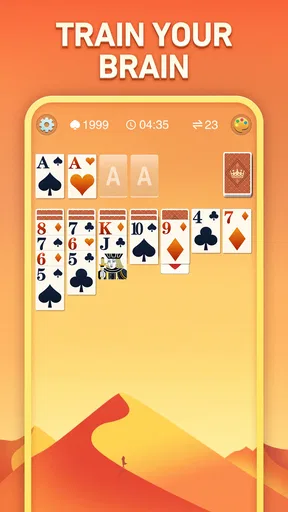
For older players, the familiar card format can be more welcoming than a new puzzle system with unfamiliar symbols and complicated menus. The store presentation specifically positions the game as a way to relax and train the brain, and I think that description makes sense when interpreted modestly. I would not treat it as a serious cognitive program, but it does provide a light exercise in concentration and sequencing.
A practical way to play without turning it into a chore
My preferred approach is to use each deal as a short decision exercise rather than rushing to finish. Before moving a card, I look at which columns are blocked, whether a hidden card can be exposed, and whether an empty space would actually help. That habit is more valuable than tapping every apparently legal move. It also reduces the frustration that comes from discovering later that an early choice limited the rest of the board.
One useful routine is to reserve the game for a defined break. I might play one or two rounds after lunch, then close it instead of letting a supposedly relaxing activity become another endless feed. Because the sessions are self-contained, the game supports that boundary better than apps built around daily streaks, multiplayer pressure, or constant notifications.
Another practical tip is to treat difficult deals as a lesson in order rather than as a test of speed. When a position stalls, I mentally review the last few choices and ask whether I exposed a card too soon or used a sequence where a different move would have opened more options. Even when I do not solve the board, that review makes the next round more deliberate.
Where it stands beside other card games
Compared with a physical deck, this app is more convenient because I do not need a table, enough space to lay out cards, or time to reshuffle. The phone handles the setup, so it is easier to play during travel or in a waiting room. A real deck still feels better for someone who enjoys the tactile movement of cards, but the digital version wins on portability and immediate access.
Compared with online multiplayer card games, Solitaire Card Game is much less demanding. There is no opponent to outthink and no match timer pushing me to act quickly. That is a strength for relaxation, but it also means the game may feel solitary in the literal sense. Players who enjoy bluffing, ranking systems, chat, or head-to-head tension should look toward a competitive card title instead.
It also differs from elaborate solitaire suites that emphasize many named variants, visual themes, achievements, or long-term progression. The appeal here is the familiar core and the ability to play offline. If someone wants a large catalogue of rules to study, this may feel restrained. If someone wants one dependable type of card puzzle without a lot of learning overhead, that restraint is useful.
The friction I noticed during longer use
The same simplicity that makes the game approachable can make it feel limited after repeated sessions. Once I have settled into the basic rhythm, I may want more variety or a stronger sense of progression. A player who needs fresh mechanics every few days could lose interest, especially if they already have a favorite solitaire app with more modes.
There is also a difference between “offline” and “deeply customizable.” Offline play is valuable, but it does not automatically mean the game will satisfy every preference about card appearance, layout, difficulty, or personal goals. People who carefully compare rule variations or want extensive control over how a game behaves should examine the available experience on their device before committing to it as their only card game.
Another limitation is emotional rather than technical: a quiet solitaire game does not create much excitement. I enjoy that when I am tired, but it can feel flat when I want a meaningful challenge or a dramatic payoff. There is no story to carry me forward, no opponent reacting to my decisions, and no broader adventure surrounding the cards. That is not a flaw for the intended use, but it is a clear reason not to recommend it to every gamer.
I also would not confuse the brain-training language with a promise of measurable improvement. Playing requires focus and planning in the moment, which I find worthwhile, but the benefit is best viewed as an enjoyable mental habit. Anyone looking for structured lessons, progress tracking, or a formal training plan would be better served by a dedicated puzzle or learning app.
Who should install it
I think this game is particularly well suited to people who want a familiar card puzzle that starts quickly and does not depend on a connection. It can work for casual players, older adults who prefer recognizable rules, and anyone who wants a quiet alternative to social feeds. The Everyone age rating also makes it easy to consider for a shared household device, although each player will still have different expectations about challenge and variety.
It is also a sensible choice for someone using an older Android phone. Since the minimum requirement is Android 6.0, the app is not limited to recent hardware. I would still keep expectations realistic: compatibility makes installation possible, but it does not turn a simple game into a modern, feature-packed card collection. Its value comes from being easy to pick up, not from pushing a phone’s capabilities.
People who should skip it are equally easy to identify. I would not choose it as my main card game if I wanted multiplayer competition, a large selection of distinct variants, a substantial achievement system, or a strong narrative. I would also look elsewhere if the physical sensation of handling cards is central to the enjoyment. In those cases, a tabletop deck or a more specialized digital card app would likely be a better match.
What its popularity tells me—and what it does not
The game has reached over five million installs, with an average rating of 4.8 from around thirty-six thousand ratings and roughly three thousand reviews. Those figures suggest that the straightforward concept connects with a broad audience, and they fit my impression that the app is designed for accessibility rather than a narrow group of expert players.
Popularity alone is not a reason for me to install any game, though. A large audience cannot answer whether I personally need more variety, whether the visual presentation suits my taste, or whether solitaire is the kind of repetition I enjoy. I use those numbers as reassurance that the basic idea has found its audience, not as proof that it will replace every other card game.
The developer, Degoo ltd, has kept the identity of the product clear: it is a card game built around solitaire, offered free of charge. That clarity helps set expectations before installation. I am not downloading it for a large online community or a complex collection system; I am downloading it for accessible rounds that can fit around ordinary life.
How I would use it day to day
Imagine a train journey with unreliable reception. I could begin a round before leaving, put the phone away when the train becomes busy, and return to the game later without needing to organize anything. The same workflow works during a power outage, in a waiting area with poor coverage, or at home when I want to reduce distractions by switching off connectivity. The important benefit is not just that the game is playable offline; it is that the offline design supports a calmer routine.
For a senior family member, I would introduce it by explaining one small goal at a time: first identify available moves, then look for ways to uncover blocked cards, and finally build toward completion. I would avoid presenting it as a test of intelligence. The game is more enjoyable when mistakes are treated as part of the puzzle rather than as evidence that the player is doing badly.
For myself, I would use it as a reset between demanding tasks. A short round gives my attention somewhere concrete to go, unlike an endless stream of news that can leave me more distracted. The trade-off is that I need to choose when to stop. Since solitaire can be repeated indefinitely, a timer or a personal session limit is a sensible habit if I am trying to protect my focus.
My final recommendation
Solitaire Card Game succeeds because it understands the value of an uncomplicated card break. It is free, accessible to Everyone, compatible with Android 6.0 and later, and built around offline solitaire rather than pressure, competition, or a complicated learning curve. I appreciate that I can approach it casually while still making decisions that reward patience and planning.
Its weakness is the other side of that design. Players seeking deep variety, social competition, or a long progression system may find the experience too narrow. Even a fan of solitaire may eventually want a broader set of rules or more customization. I would not install it expecting a complete card-gaming universe.
For the right person, however, that narrow focus is exactly the point. If you want a dependable, low-pressure way to fill a few quiet minutes, especially when you may be offline, I think this is an easy recommendation. If your ideal card game needs opponents, novelty, or dramatic stakes, choose something more ambitious. My verdict is that this is a strong everyday solitaire companion: calm, practical, and most enjoyable when used as a small mental pause rather than as your only game.
Verdict
Strengths of Solitaire Card Game
- Simple rules make it easy for beginners to start playing.
- Works well for short sessions during commutes or breaks.
- Multiple layouts provide variety beyond the classic game.
- Smooth card controls make moves comfortable on touchscreens.
- Offline play is useful when there is no internet connection.
Limitations of Solitaire Card Game
- Frequent ads may interrupt games, especially between rounds.
- Some advanced features may require in-app purchases.
- Random deals can occasionally feel repetitive over time.
- Small cards may be difficult to read on compact phone screens.
- Battery use can increase during longer play sessions.
Other Releases by Degoo ltd
View All
Spider Solitaire Card Game
Board4.7
Similar Picks in This Category
View All
Solitaire - Classic Card Games
MobilityWare4.6

UNO!™
Mattel163 Limited4.3

Spider Solitaire: Card Games
MobilityWare4.6

Solitaire.com - Classic Cards
Tripledot Studios Limited4.7

Plants vs. Zombies™ Heroes
ELECTRONIC ARTS4.1

Hearthstone
Blizzard Entertainment, Inc.4.1
Frequently Asked Questions
What is Solitaire Card Game, and how is it played?
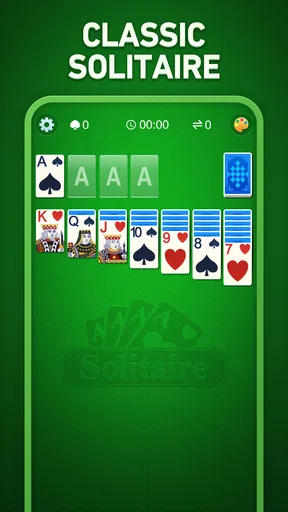
Solitaire Card Game is a single-player card game based mainly on the classic Klondike format. The objective is to arrange cards into foundation piles by suit, starting with the ace and continuing in ascending order through the king. During a game, you move cards between tableau columns, reveal hidden cards, and use the stock and waste piles to find useful cards. The rules are easy to understand, although winning consistently requires planning and careful sequencing.
Can Solitaire Card Game be played offline?
Yes, Solitaire Card Game can generally be played without an internet connection once it has been installed. Offline access is useful when traveling, commuting, or playing in places with limited connectivity. Some features may still require internet access, such as advertisements, cloud synchronization, online statistics, daily challenges, leaderboards, or updates. The main single-player card games remain available offline, but the exact features can vary depending on the version and device.
Does Solitaire Card Game include different modes or customization options?
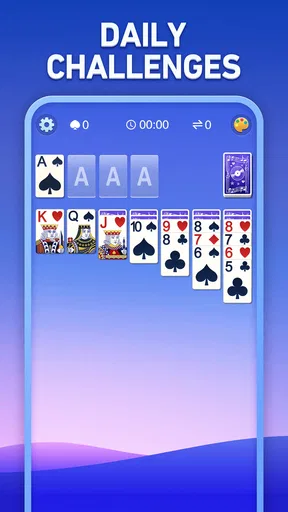
Most versions of Solitaire Card Game offer more than one way to personalize the experience. Depending on the release, you may find classic Klondike variations, draw-one or draw-three settings, daily challenges, timed games, and statistics tracking. Many editions also let you change card designs, backgrounds, animations, sound effects, and display preferences. Before downloading, check the app listing because available modes and customization tools can differ between Android and iOS versions.
Is Solitaire Card Game free to download, and does it contain advertisements?
Solitaire Card Game is commonly available as a free download, but free access may be supported by advertisements or optional in-app purchases. Ads can appear between games, on menus, or after completing a challenge, while paid options may remove advertising or unlock additional themes and features. The basic gameplay is usually accessible without paying, although the exact pricing, advertising frequency, and purchase options should be reviewed on the relevant app store page.
Is Solitaire Card Game suitable for beginners and older players?
Yes, Solitaire Card Game is generally suitable for beginners, casual players, and older users because the controls are straightforward and the rules are familiar. Most versions use simple tap or drag gestures, clear card layouts, and helpful hints for players who are still learning. However, small text, animations, or crowded menus may affect accessibility on some devices. Adjusting display settings and choosing a simpler theme can make the game more comfortable to play.
Play our best games!


